Baker & Taylor Files for Chapter 11 Bankruptcy, Ending 198 Years as America's Premier Book Distributor
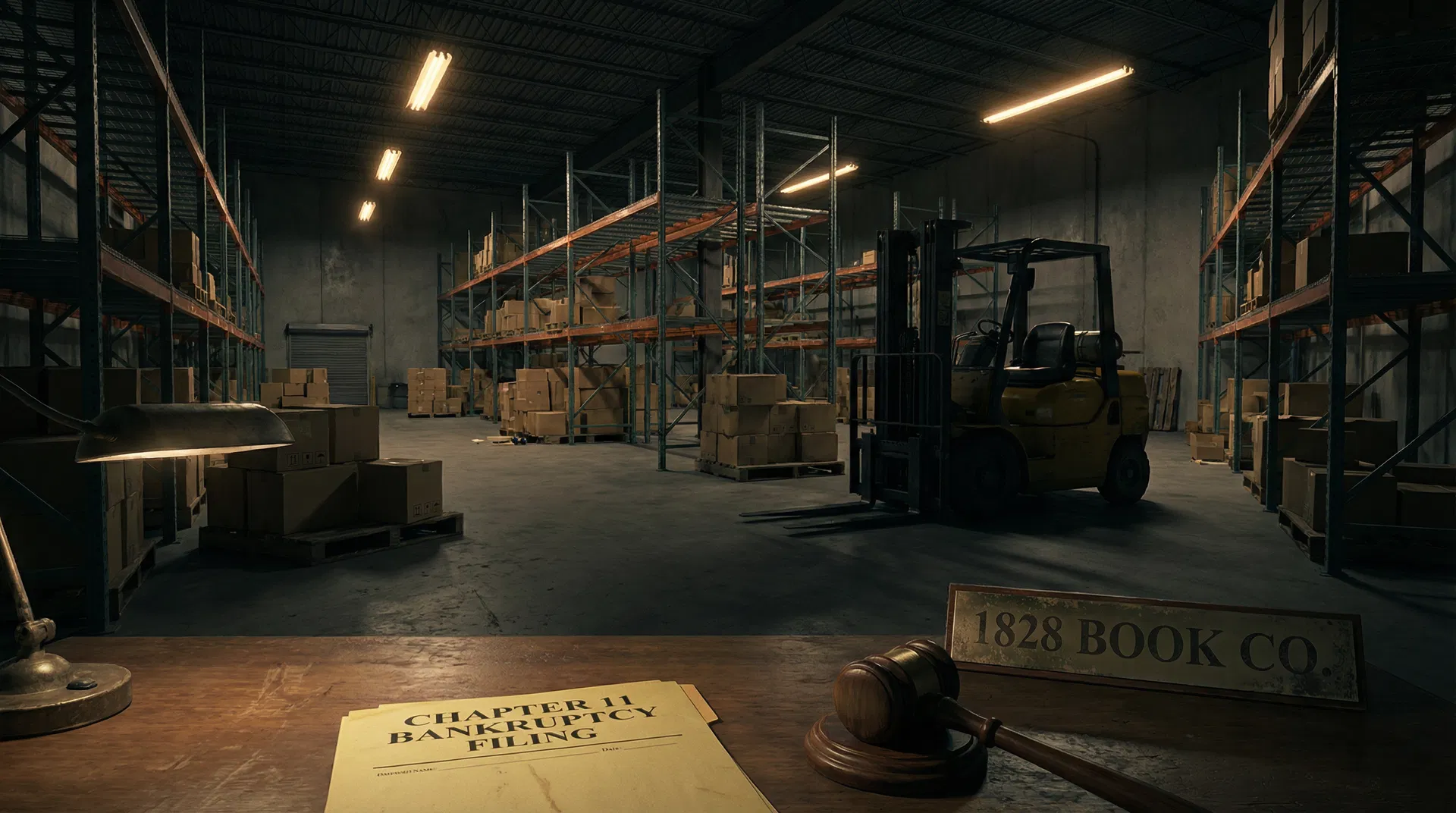
Baker & Taylor, the 198-year-old book distributor founded in 1828, has filed for Chapter 11 bankruptcy in the District of New Jersey with $100M–$500M in liabilities and just $1M–$10M in assets. Its largest unsecured creditors include Penguin Random House ($23.3M), Simon & Schuster ($16.5M), HarperCollins ($15.5M), and Macmillan's MPS ($3.8M). Libraries that prepaid for undelivered books are owed approximately $33 million.
Analysis
The Chapter 11 filing by Baker & Taylor on March 16 is not a surprise — the company announced in October 2025 that it would shut down operations and liquidate assets — but the scale of the liabilities revealed in the court filing is striking. Between $100 million and $500 million owed to between 1,000 and 5,000 creditors, against just $1 million to $10 million in assets, represents a near-total destruction of value in a company that was, for most of its 198-year history, the backbone of the American library book supply chain.
The creditor list tells the story of how deeply Baker & Taylor was embedded in the publishing ecosystem. Penguin Random House is owed $23.3 million, Simon & Schuster $16.5 million, HarperCollins $15.5 million, and Macmillan's distribution arm MPS $3.8 million. These are not abstract financial claims — they represent books shipped and not paid for, credit extended on the assumption that Baker & Taylor would remain a going concern. The publishers will recover pennies on the dollar, if that.
The most troubling figure in the filing is the $33 million owed to library customers who participated in Baker & Taylor's prepayment leasing programme — libraries that paid in advance for books that were never delivered. These are public institutions, many of them already operating under severe budget constraints, that trusted Baker & Taylor with public funds. Their claims will be treated as general unsecured obligations, meaning they will rank behind secured creditors and priority claims in the distribution of any remaining assets.
Baker & Taylor's collapse is the second major distribution failure in the US book trade in recent years, following the difficulties at Ingram's library services division. Ingram has been ramping up its library services capacity to fill the void, but the transition has been disruptive. The broader lesson is structural: the economics of physical book distribution — high fixed costs, thin margins, dependence on publisher credit terms — are increasingly incompatible with a market where digital and direct-to-consumer channels are capturing a growing share of volume. The 198-year-old company that survived the Civil War, two World Wars, and the rise of Amazon could not survive the combination of COVID-19 disruption, the shift to digital, and the loss of its private equity backers' patience.