Spotify's Audiobook Stage at LA Times Festival of Books Signals the Format's Arrival at the Literary Mainstream
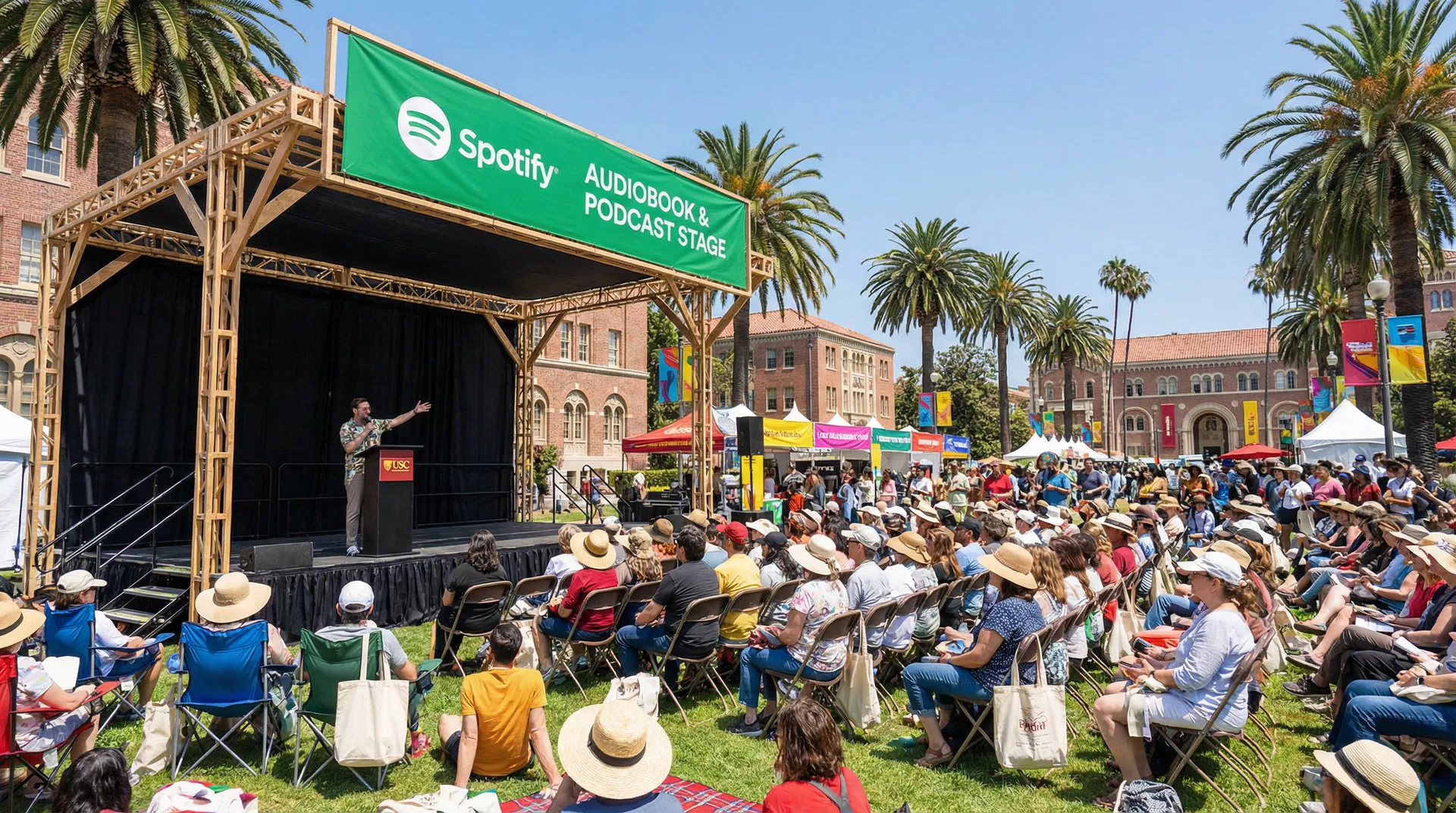
The 31st annual Los Angeles Times Festival of Books (April 18-19, 2026, at the University of Southern California) will debut a dedicated Audiobook and Podcast Stage presented by Spotify — the first time the festival has given audio formats their own dedicated programming space. The stage will feature audiobook narrators, podcast hosts, and industry experts alongside the festival's main author lineup.
Analysis
The Los Angeles Times Festival of Books has been a fixture of American literary culture since 1996, drawing hundreds of thousands of visitors to the University of Southern California campus each spring for author talks, panel discussions, and the kind of book-browsing that no algorithm can replicate. For its 31st edition in April 2026, the festival is doing something it has never done before: giving audio formats their own dedicated stage. The Audiobook and Podcast Stage presented by Spotify will sit alongside the festival's eight outdoor stages, featuring audiobook narrators, podcast hosts, and industry experts in programming that treats audio as a primary literary form rather than an ancillary product. The symbolism is not subtle.
Spotify's sponsorship of the stage is a statement of intent from a company that has been aggressively expanding its audiobook business since acquiring Findaway in 2022 and integrating audiobooks into its Premium subscription in 2023. The platform reported a 36% increase in audiobook users and a 37% increase in listening hours in the year to early 2026, and its catalogue now exceeds 700,000 titles. By attaching its name to a dedicated stage at one of the country's most prestigious literary festivals, Spotify is positioning itself not merely as a distribution platform but as a cultural institution with a stake in the health of the broader reading ecosystem. That positioning matters as the company competes with Audible, which remains the dominant audiobook platform by market share, and with Apple Books, which has been quietly growing its audio catalogue.
The decision to include podcast hosts alongside audiobook narrators on the same stage reflects a deliberate blurring of the line between audio formats that the publishing industry has been slow to acknowledge. For listeners, the distinction between a serialised audio drama, a narrative podcast, and a traditionally narrated audiobook is increasingly porous; all three compete for the same listening time and are discovered through the same platform interfaces. Spotify, which operates in all three categories, has a commercial interest in treating them as a unified audio entertainment category rather than separate silos. The LA Times Festival of Books stage gives that framing cultural legitimacy.
For the audiobook industry, the festival appearance is a welcome signal that audio is being taken seriously as a literary form rather than a convenience product. Audiobook narrators — who have historically been invisible at literary events focused on authors and editors — will have a platform at one of the country's most visible book festivals. That visibility matters for the craft: the best audiobook narrations are performances in their own right, and the festival stage gives narrators an opportunity to demonstrate that to an audience that may not have considered the artistry involved. Spotify's decision to feature its 2025 top audiobook narrator in the lineup is a small but meaningful acknowledgment of that craft.
The broader context is an audiobook market that has been growing steadily while print and e-book sales have plateaued. The Audio Publishers Association reported double-digit revenue growth for the US audiobook market in 2025, driven by subscription models and the expansion of listening occasions — commuting, exercise, household tasks — that print cannot serve. Spotify's LA Times Festival stage is a bet that audiobooks are ready to claim a permanent place in the cultural conversation about literature, not just the commercial conversation about media consumption. Whether the festival audience agrees will be one of the more interesting data points of the 2026 literary season.