AWP 2026: Literary Community Pushes Back on AI, But Nuances Emerge
The Association of Writers & Writing Programs' 2026 conference in Baltimore (March 4–7) featured extensive debate about generative AI and literature. Panels reached broadly skeptical conclusions — AI 'doesn't generate meaning or truth,' human editors cannot be replaced — but nuances emerged: some writers acknowledged using AI for practical tasks, and at least one panelist suggested using AI to explore genre conventions.
Analysis
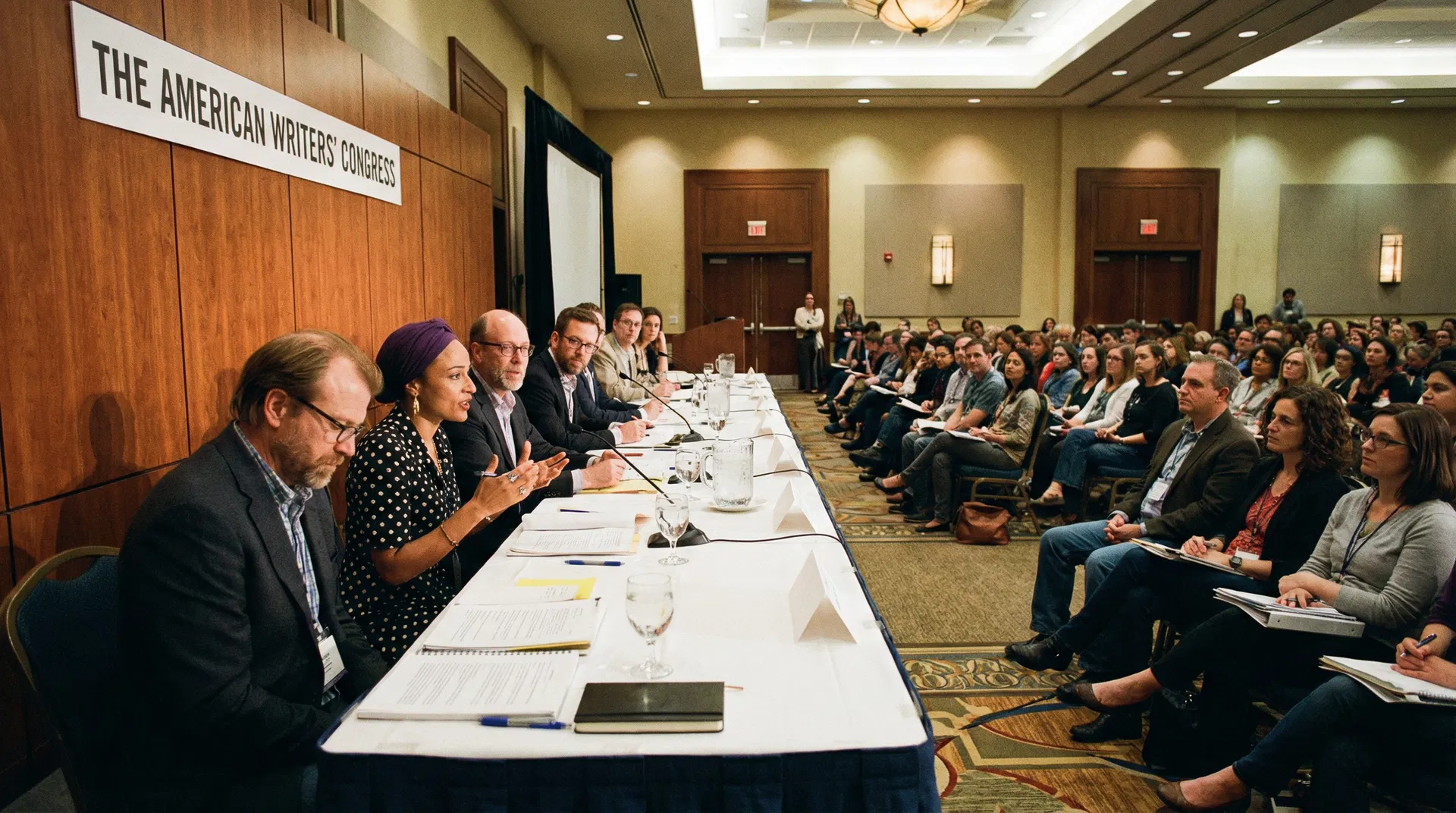
The Association of Writers & Writing Programs' annual conference has always been the place where the literary community takes its own temperature — and the 2026 gathering in Baltimore, held from March 4 to 7, registered a reading that was skeptical of generative AI but more textured than a simple rejection.
The dominant position across three major AI-focused panels was clear: generative AI systems 'don't generate meaning or truth,' as moderator Christina Frey put it in the 'AI and the Editor' panel, and should not be used for writing. Tanesha Curtis, an author and editor, argued that human editors cannot be replaced because AI lacks 'an ear for clarity or nuance.' Science fiction author Sequoia Nagamatsu went further, arguing that fiction should portray AI technologies as 'inherently harmful in their current form' — a position that reflects a strand of thinking in the literary community that sees the technology not as a neutral tool but as an expression of specific corporate interests and values.
But the nuances that emerged were at least as interesting as the consensus. Freelance editor Linda Ruggeri acknowledged using AI for 'practical' aspects of her work — checking that a manuscript's table of contents is comprehensive, for instance. Katherine Pickett, while cautioning against using AI for writing, raised eyebrows by suggesting that writers might use it to explore genre conventions, such as asking it to rewrite a piece of women's fiction in the style of romantic suspense. Vauhini Vara, whose essay collection 'Searches: Selfhood in the Digital Age' was a PW Best Book of 2025, has published work that includes AI-generated text — but as a deliberate artistic choice to highlight the contrast between human expression and the chatbot's simulacrum, not as a collaborative tool.
Karen Hao, author of 'Empire of AI,' offered perhaps the most personally revealing statement: she doesn't use AI because she worries 'the language will affect my writing and thinking.' That concern — about cognitive contamination rather than plagiarism or labor displacement — is a distinctive anxiety that the literary community has articulated more clearly than any other professional group. It suggests that the debate at AWP is not primarily about economics or copyright, but about what it means to think and write as a human being in an environment saturated with machine-generated language. That is a more interesting question than most AI policy discussions acknowledge.