AI Voice Accelerates: Mistral Launches Voxtral TTS and ElevenLabs Deepens IBM Enterprise Partnership
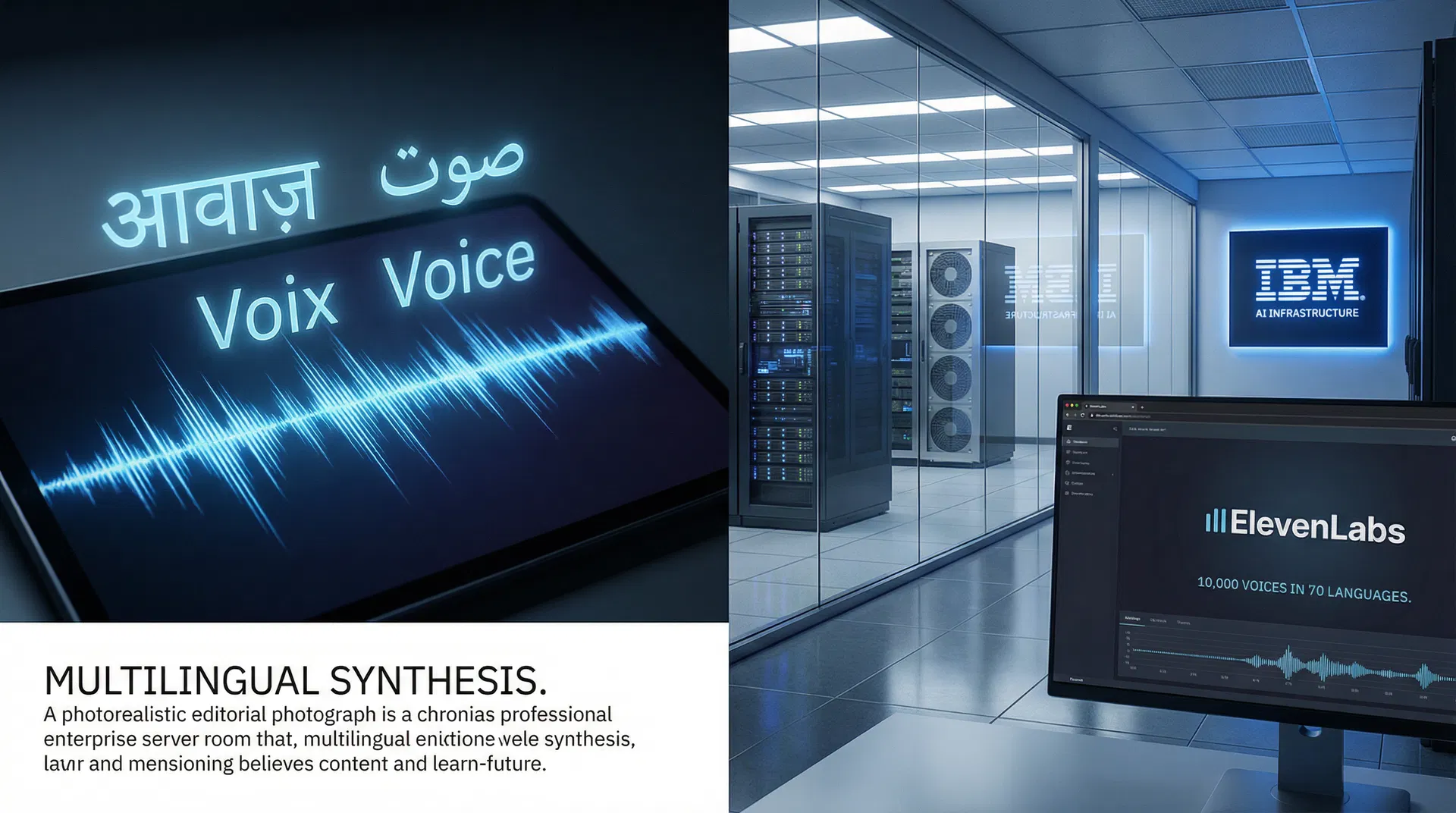
Two significant AI voice developments landed within 24 hours of each other. Mistral AI released Voxtral, a 4-billion-parameter open-weight TTS model supporting nine languages with zero-shot voice cloning from three seconds of reference audio. Simultaneously, ElevenLabs deepened its IBM watsonx Orchestrate integration, bringing over 10,000 voices in 70 languages to enterprise AI agents with HIPAA-compliant data handling. Together, the announcements signal that AI voice has bifurcated into an open-source democratisation track and a high-compliance enterprise track.
Analysis
Two AI voice announcements in a single day is no longer unusual — the pace of development in this space has been relentless since 2023 — but the particular pairing of Mistral's Voxtral and the ElevenLabs–IBM deepening is analytically interesting because the two developments represent opposite ends of the market.
Voxtral is a statement about openness. A 4-billion-parameter model that achieves zero-shot voice cloning from three seconds of reference audio, supports nine languages including Hindi and Arabic, and is released as open-weight is a direct challenge to the commercial TTS incumbents. Mistral's claim that Voxtral outperforms ElevenLabs Flash v2.5 in naturalness while maintaining a time-to-first-audio of approximately 100 milliseconds is aggressive, and the open-weight release means the claim can be tested by anyone. For smaller publishers, independent audiobook producers, and developers building reading tools for underserved language markets, Voxtral represents a meaningful reduction in the cost of high-quality voice synthesis.
The ElevenLabs–IBM announcement represents the opposite trajectory: consolidation into enterprise infrastructure. Integrating premium TTS and STT into IBM watsonx Orchestrate — with PCI compliance, HIPAA-compliant data handling, and zero retention modes — is not a product for independent creators. It is a product for banks, insurance companies, and government agencies that need voice-first AI agents at scale. The 10,000 voices in 70 languages figure is less about creative diversity and more about the ability to deploy consistent branded voices across global operations without managing multiple vendor relationships.
For the publishing industry, the implications run in both directions. Open-weight models like Voxtral will continue to lower the barrier to AI narration, accelerating the displacement of human voice actors in the lower tiers of the audiobook market. Enterprise integrations like ElevenLabs–IBM will embed AI voice into the customer-facing infrastructure of the financial and healthcare sectors, normalising synthetic speech in contexts where human narration was previously expected. The question for publishers is not whether to engage with AI voice, but which track — open or enterprise — aligns with their distribution strategy.