Beware Platform Dependency: Why Social Media Reliance Is a More Immediate Threat to Publishers Than AI
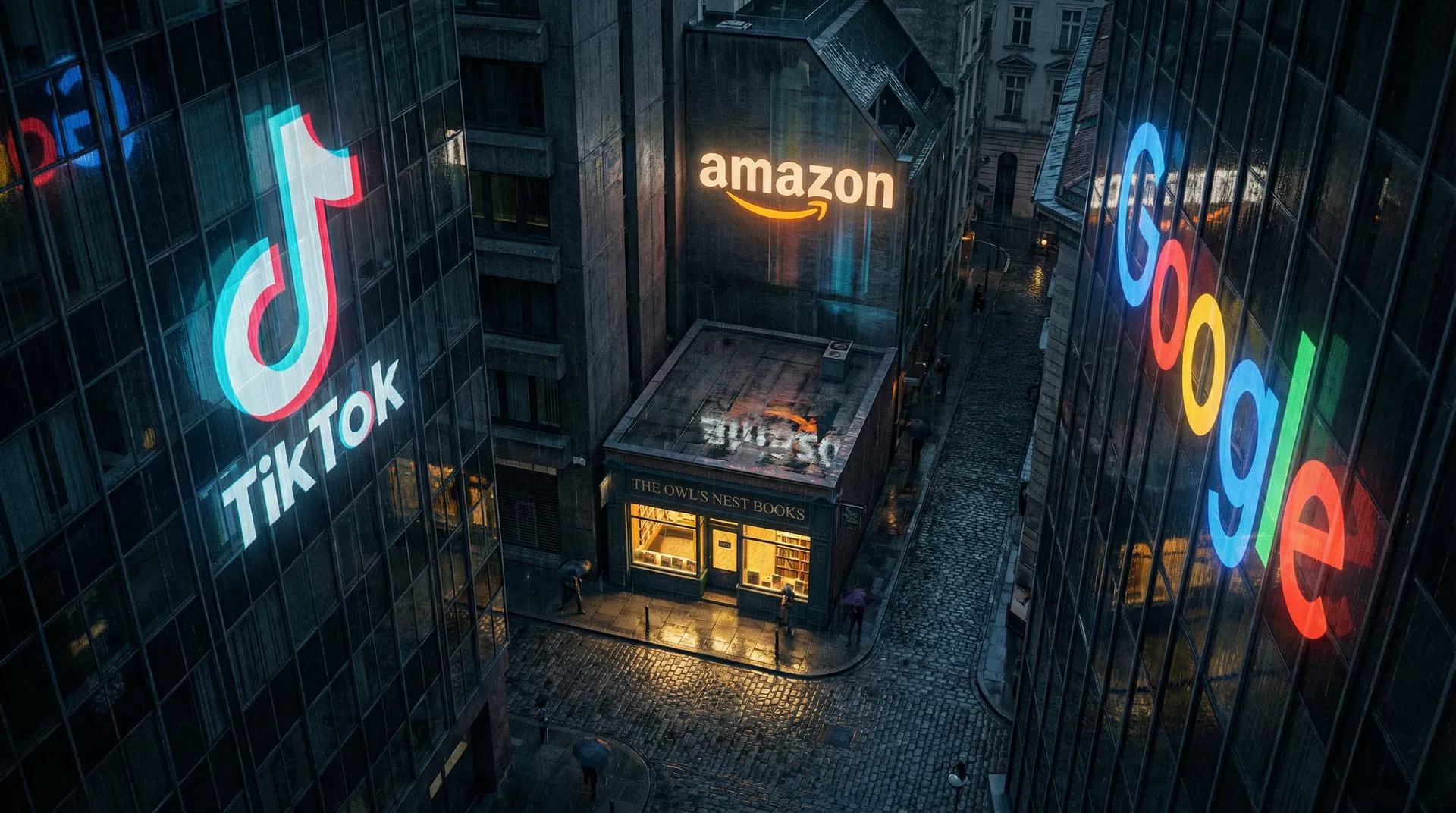
A Bookseller commentary by journalist Raphael Tsavkko Garcia argues that publishers' structural dependence on Amazon, TikTok, Google, and Meta represents a more immediate and existential threat than AI. Garcia draws on the news industry's cautionary experience — where publishers built audiences on social platforms only to see traffic collapse when algorithms changed — and urges book publishers to invest in direct-to-consumer channels, newsletters, and proprietary data systems. Chartbeat data shows a 60% decline in referral traffic for small publishers versus 22% for large outlets. AI platforms currently contribute less than 1% of total publisher pageviews despite rapid growth.
Analysis
Raphael Tsavkko Garcia's Bookseller commentary is a deliberate provocation aimed at an industry that spent the week of LBF 2026 almost entirely focused on AI — and it is a provocation worth taking seriously.
The platform dependency argument is not new. Publishers have been warned about Amazon's market power for a decade, and the news industry's experience with Facebook's algorithm changes in 2018 — which collapsed referral traffic for publishers who had built their distribution strategies around the platform — is well documented. What Garcia's piece adds is a synthesis of the current data that makes the argument more urgent than it has been before.
The Chartbeat figures are the most striking element: a 60% decline in referral traffic for small publishers versus 22% for large outlets. This asymmetry matters because it reveals that platform dependency is not a uniform risk — it is a risk that falls disproportionately on the publishers who can least afford it. Large publishers with diversified distribution, substantial direct-to-consumer operations, and the marketing budgets to build brand awareness independent of algorithmic amplification are relatively insulated. Small and mid-sized publishers, whose discoverability depends heavily on BookTok virality, Google search visibility, and Amazon recommendation algorithms, are exposed to the full force of platform shifts.
The AI traffic figure — less than 1% of total publisher pageviews — is a useful corrective to the hype around AI-driven discovery. Publishers who are investing heavily in optimising their content for AI search engines (a practice that has been called "GEO" — Generative Engine Optimisation) are chasing a traffic source that does not yet exist at meaningful scale, while neglecting the platform dependencies that are already affecting their businesses today.
Garcia's strategic recommendation — invest in direct-to-consumer channels, newsletters, and proprietary data systems — is correct but underspecified. The practical challenge for small and mid-sized publishers is that building owned channels requires upfront investment in technology, content, and marketing that many cannot afford, and the returns are long-term and uncertain. The publishers who have done this most successfully — Substack-native authors, publishers with strong email lists, specialist presses with loyal communities — have typically done so by building around a specific audience rather than trying to replicate the broad reach of platform-dependent discovery.
The deeper point in Garcia's argument is about data ownership. Every transaction that happens on Amazon, every BookTok view, every Google search click is a data point that belongs to the platform, not the publisher. Publishers who have built their discovery strategies around these platforms have, in effect, outsourced their understanding of their own readers. The publishers who will be most resilient in the next decade are those who have invested in first-party data — email addresses, purchase histories, reading preferences — that they own and can use independently of any platform's algorithmic decisions.