The AI Overview Citation Gap: Half of All AI-Cited Pages Don't Rank in the Top 10 — BrightEdge Study
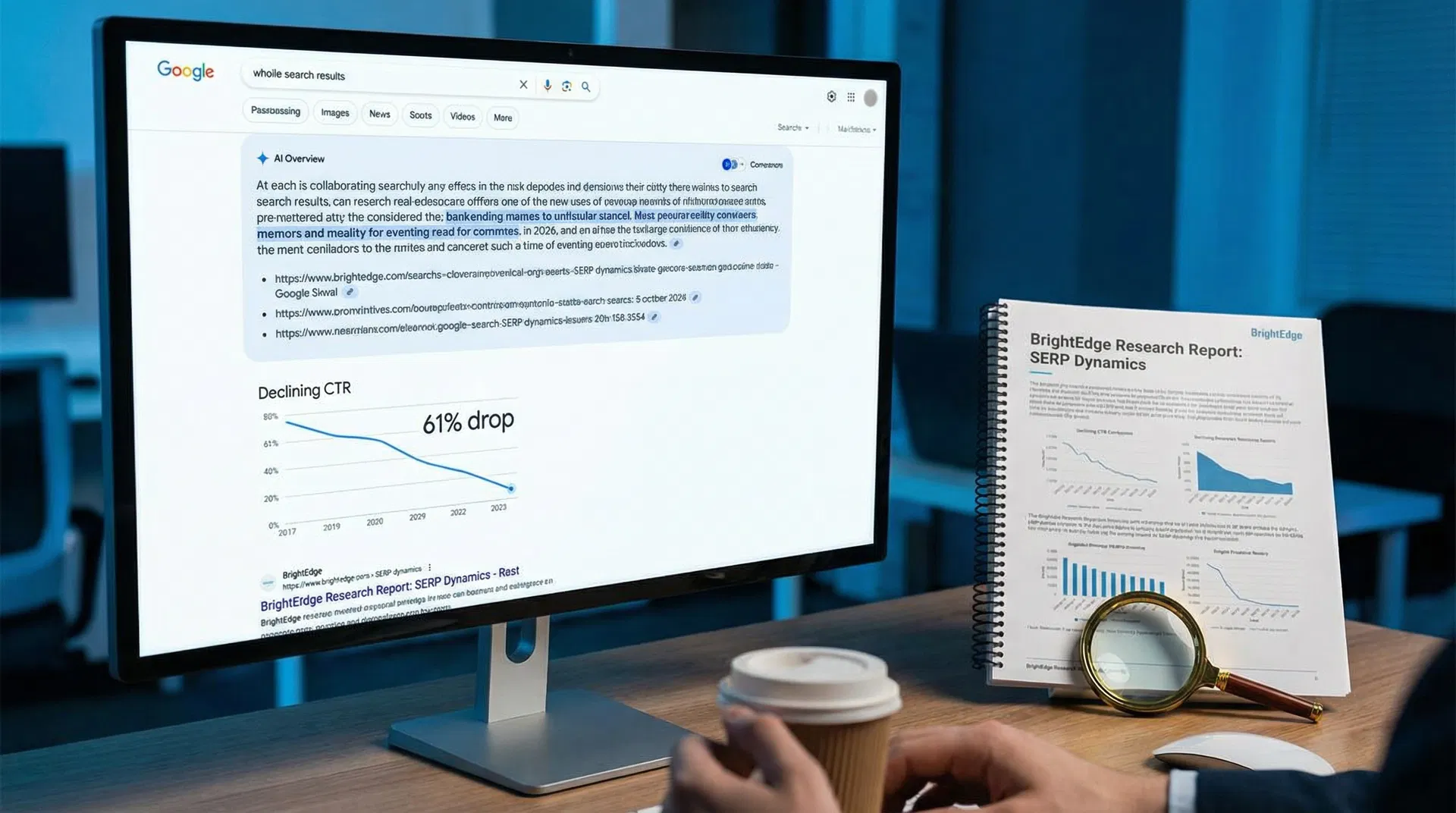
A BrightEdge study reveals that 45.5% of pages cited in Google AI Overviews still don't rank in the top 10 organic results. For informational queries, organic CTR has dropped 61% when an AI Overview is present. However, being cited in an AI Overview increases organic CTR by 35% and paid CTR by 91%, creating a bifurcated search landscape for publishers.
Analysis
The BrightEdge study is the most comprehensive quantitative analysis yet of how Google's AI Overviews are reshaping the relationship between content quality, search ranking, and traffic. Its central finding — that nearly half of all AI citations come from pages that do not rank in the top 10 organic results — is both counterintuitive and strategically significant. It means that Google's AI retrieval system is operating on a different logic than its traditional ranking algorithm, and that publishers who have optimised exclusively for the latter may be invisible to the former.
The mechanism behind this divergence is structural rather than algorithmic in the traditional sense. Google's AI system is not simply pulling from the highest-ranked pages — it is pulling from pages whose content is most directly usable as an answer. Jim Yu of BrightEdge describes this as the difference between "search-visible" and "AI-visible" content. A page that ranks highly because of its domain authority, backlink profile, and keyword density may still be bypassed by the AI system if its actual answer to the user's question is buried in the fifth paragraph of a 3,000-word article, or if its heading structure does not clearly signal what the content addresses.
The CTR data tells a stark story about the commercial consequences. A 61% decline in organic click-through rates for informational queries when an AI Overview is present is not a marginal effect — it represents a fundamental shift in how users interact with search results for the category of query that most publisher content is designed to answer. The 26% zero-click rate for AI Overview queries (up from 16% for traditional results) confirms that a growing proportion of users are receiving their answers directly from the AI summary and never visiting the source page at all.
The counterweight to this is the 35% CTR uplift for pages that are cited within AI Overviews. This creates a bifurcated landscape: publishers whose content is structured for AI retrieval will see their traffic amplified; publishers whose content is not will see it eroded. The practical implication is that the investment required to optimise for AI citation — clear heading hierarchies, self-contained answer units, direct responses to specific questions — is not optional for publishers who depend on search traffic. It is the new baseline for visibility in a search environment where AI Overviews appear in 16% of all queries and 57% of informational ones.