Chicken Soup for the Soul Sues OpenAI and Seven AI Firms Over 'Single Act' Copyright Theory
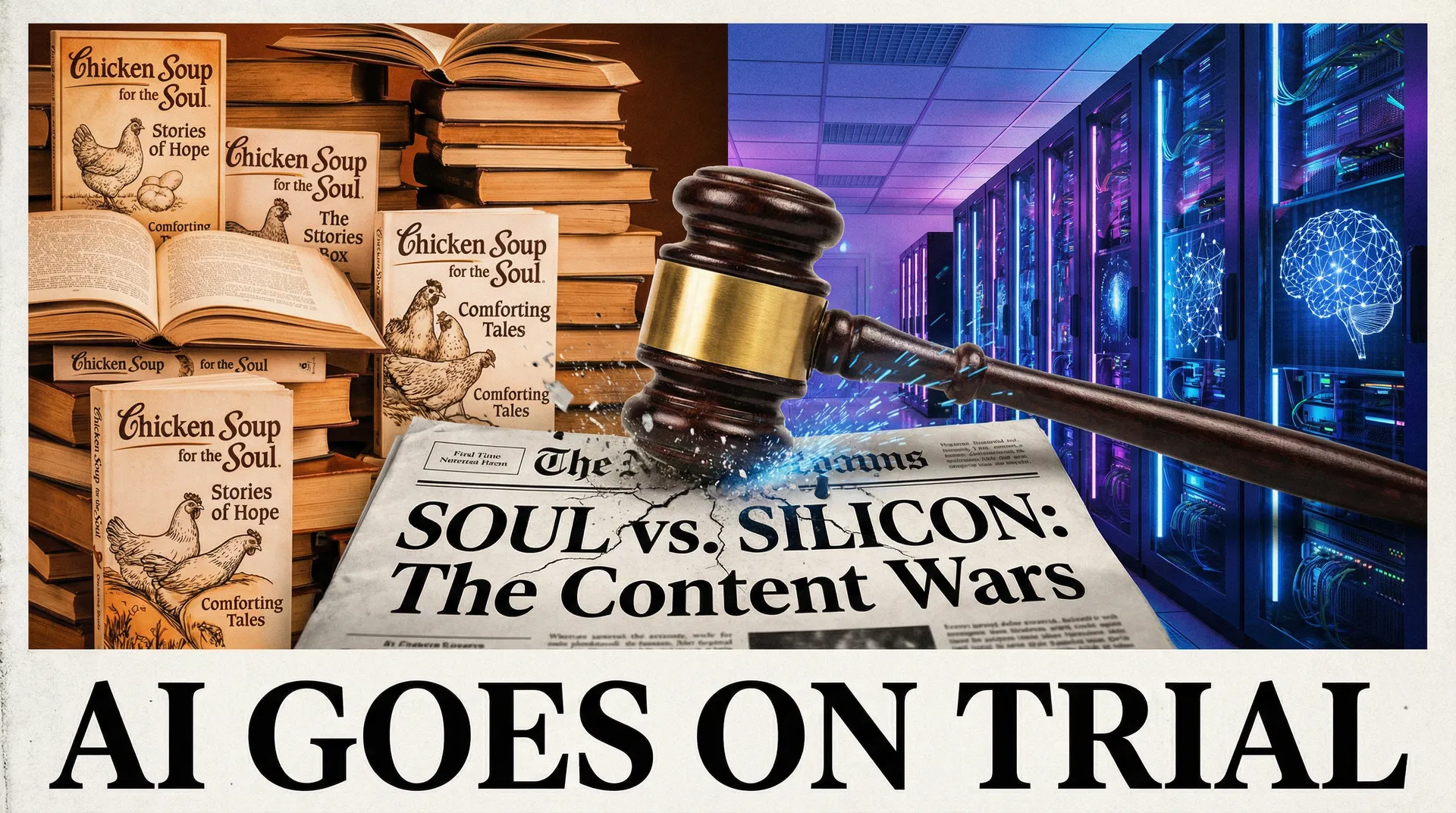
Chicken Soup for the Soul has filed a copyright lawsuit in the Northern District of California against OpenAI, Anthropic, Google, Meta, xAI, Perplexity, Apple, and Nvidia, alleging that the entire generative AI industry was built on a foundation of pirated books traced to a single 2018 LibGen download by an OpenAI employee. Over 1,000 authors representing more than 5,000 works have joined the action.
Analysis
The Chicken Soup for the Soul lawsuit is the most legally ambitious AI copyright complaint filed to date, and its central innovation — the "single act" theory — deserves careful attention from anyone tracking how courts will ultimately resolve the AI training data question.
The complaint's argument is architecturally elegant. Rather than treating each defendant's training pipeline as a separate infringement event, the filing traces the entire industry's conduct back to one moment: an OpenAI employee's 2018 download of pirated books from Library Genesis. From that seed, the complaint argues, grew GPT-3, then Books3, then The Pile, then the wholesale adoption of shadow library datasets by every major AI lab. "Each escalation compounded the last," the filing states — a framing designed to establish a chain of causation that makes all eight defendants jointly responsible for a single originating act.
This is a significant departure from the class-action model that has dominated AI copyright litigation. The pending Anthropic settlement in the Northern District of California would pay rights holders approximately $3,000 per work — just two percent of the Copyright Act's statutory ceiling of $150,000 per willfully infringed work. The Chicken Soup complaint explicitly rejects that framework, arguing that such settlements "seem to serve Defendants, not creators," and instead seeks individualized statutory damages determined by a jury.
The choice of Chicken Soup for the Soul as plaintiff is itself strategically interesting. The franchise's tightly edited, first-person narratives — emotionally resonant, conversationally voiced, morally structured — are precisely the kind of text that makes LLMs better at sounding human. The complaint argues the series was "intentionally targeted" for those qualities, which, if proven, would support a finding of willful infringement rather than negligent or incidental use.
With 1,000-plus authors and 5,000-plus works already signed on, this case has the potential to become the defining AI copyright action of the decade — not because it will necessarily win, but because it is forcing the courts to confront the question of whether the entire generative AI industry was built, from the beginning, on stolen material.